
PART 1 – WIDER TRENDS, EVIDENCE AND FINDINGS
- Executive Summary of the Sections below created by AI
- Regulatory Complexity: Frequent legal changes and regional differences create uncertainty for property owners and investors. New rules on rentals and estate agent registration are being implemented, but processes remain unclear.
- Affordable Housing Shortage: Chronic lack of affordable housing persists. Measures to address this often have limited effect and can worsen the situation, with landlords facing increased restrictions and taxes—even on unpaid rent.
- Rental Market Pressures: Stricter rules on short-term rentals and licensing have reduced supply for long-term tenants, driving up prices and making it harder for locals and workers to find accommodation.
- Construction Trends: National construction activity fell last year, but luxury development continues in hotspots like Estepona, pushing prices higher and pricing out local workers.
- Infrastructure & Energy: Delays in electricity connections for new homes are reported. EU regulations are pushing a shift to electric heating, increasing demand on infrastructure. Tax incentives exist for energy efficiency but accessing them is complex.
- Valuation & Transparency: New standards require valuers to use internal floor area, complicating comparisons. The Notary Portal now provides sale price data at postcode level, improving transparency but lacking property-specific detail.
- Social Issues: Squatting and non-payment of rent remain significant problems, with calls for clearer legal distinctions between genuine need and criminal activity.
- Market Dynamics: High coastal prices are driving renewed interest in rural areas. Land mortgages remain difficult to obtain, and pre-fabricated homes are being promoted as a solution, though questions remain about their long-term value.
-
General
- Politics International, National and Local excuse me, but I’ll keep off those as much as I can or I’ll be writing chapters and not paragraphs!
- Weather – It’s been a cool and wet end of 2025 and start of 2026, so there should be no drought this summer. I feel sorry for the tourists in their T-shirts and shorts, whilst the ‘natives’ are all bundled up and actually closing the bar door behind them!
- Law changes
- It’s very difficult to keep up with what’s happening between ‘aspirational’ announcements by politicians, policy proposals that get stuck in voting dilemmas, and others that appear in official National or Regional Boletines, but don’t quite meet the signing approval and need to go back a few steps. A bit like ‘Escaleras y Serpientes’.
- Also, the Regions make their own regulations, often with Cataluña leading the way, but Valencia, Balearics, Las Canarias, Andalucia, Asturias, etc, all play their confusing part.
- The chronic lack of affordable housing is at the root of most proposals. Unfortunately, many result in very short-term relief and end up compounding the problems. Restrictions on rentals and generally scapegoating the landlord “who is to blame for all ills”, has resulted in their being fewer landlords, especially long-term.
- However, there’s always a silver lining for some, with the absence of penalty for occupation without the owner’s approval, rarely being severely penalised or vacating the property enforced. Those who have made a business out of it, by achieving the occupation and then ‘sub-renting’ to those families who need the home, are now moving into upmarket homes, as they know the owners probably have the money to pay them to leave.
- Whilst the State stumbles around looking for an answer the tax authorities have the law behind them to tax the landlord on the rent stated in the lease even if that rent is not being paid. Under threat of fines and interest being applied, owners must declare the ‘rent’ in their tax submissions and pay tax on it. Residents of Spain and EU citizens have means to obtain repayment, but those are denied to non-EU residents.
- Short-term and tourist rentals have been the means of many owners trying to avoid the long-term problems, but the regulations are catching up with them in that they must apply for renewal of their licence every year and again fines are large if they are found to be renting without a licence. These requirements mean that buyers cannot responsibly budget on parts of the costs being covered by tax-free cash rentals, as, if denounced to the authorities or an advert is followed up, the fines will be many times more than the benefits. This must be limiting demand for property.
- And the tax authorities are pressuring that short-term rentals should have 21% IVA applied as they are a business in the same way as hotels.
- It has to be said that competition from investors with ‘Buy-to-let’ mortgages and Airbnb style direct tenant arrangements has meant that many local residents have been priced out of the buying and even rental market.
- It’s not just Spain’s problem, but the Costas and Cities here are struggling to find answers for their homeless, with turning a blind eye to squatting being a part solution that doesn’t cost the authorities.

- Squatting and Non Payment of rent.
- Another subject that is touched on above and below but is vitally important to the social fabric of Spain and thus the property industry. Just because it’s a luxury home, don’t think it can be ignored. Your house could be next when you leave on holiday!!
- The voice of reason without political dogma – Today, 23rd January, one of the Supreme Court Magistrates is quoted in Idealista as saying – “the obligation to provide housing to those who lack it falls on public administrations, not private owners”. From his perspective, he warned, “that property owners should not be used as an indirect solution to a structural housing problem.”
- He needs all the support the property industry can give him to counter the ‘ownership/landlord is bad’ thinking. Owners with squatters, where it’s a genuinely homeless family, should be compensated by the whole of society i.e. the Government. Where it’s just criminal opportunism, it should be treated by the law as such and the squatters removed immediately and dealt with as criminals.
- Construction fell last year
- Counter to expectation, it’s reported that construction activity in Spain reduced last year. It certainly can’t have been referring to Estepona where Survey Spain is based as every parcel of land around our office now has a sign indicating another new high quality and high priced development is about to start. That’s part of the problem, in that all the land, resources and skilled personnel are taken up by housing competing to be better, glitzier and more expensive than the one next door. The prices are increasing monthly so that there is no way the workers or trades people serving them can possibly afford to live there. So where do they stay, especially over the summer when the quieter car parks and cul-de-sacs have cars and vans with waiters, labourers and other lower paid workers sleeping there, finding it’s the only affordable way to live and work?
- Electricity
- So, at last, you’ve signed at the notary, paid half a million or often much more for your off-plan apartment, only to be told by the electricity company that you cannot be supplied and they don’t know when you will be. That can’t be right, but the house has a Habitation Certificate so you had to sign and pay. If the Promotor of the development can be shown to have known of the problem, then you have a possibility of compensation. But the law moves slowly in Spain and the Promotor will fight it all the way. The time to fight is to have a working connection to water and electricity guaranteed in the initial contract, but again, in the rush to buy, the developer may just say the man in the queue behind you doesn’t demand that so I’ll sell to him.
- The demand for electricity is certainly rising as oil and gas heating is no longer permitted to be installed, and properties using gas or oil will have a 10-15% EU tax added to their bills in 2027 and must have the heat source changed to electric by 2035. Electric cars and all sorts of other demands will increase the infrastructure requirement over the next few years.
- Tax benefits for Reducing energy use.
- Tax deductions are understood to be available for expenses to reduce heating and cooling demand by at least 7% or decrease non-renewable primary energy consumption by 30%.
- Urbanisation communities are also being encouraged with grants to minimise the overall energy use, so there is something coming back to the owner/occupier.
- Obtaining these benefits is unlikely to be simple, but they are available for those who persevere.
- Local Capital Gains tax
- So, you decide it’s too much hassle, we’ll just sell and move to a poorer weather area. They’ll still get you with the Plus Valia, being the tax on the notional increase in land value under the property you own. And at the beginning of the year that’s just been changed, with greater tax on those who move house relatively soon after buying, whilst longer term owners who sell will be taxed less. It seems strange, but that’s the final effect.
- Train
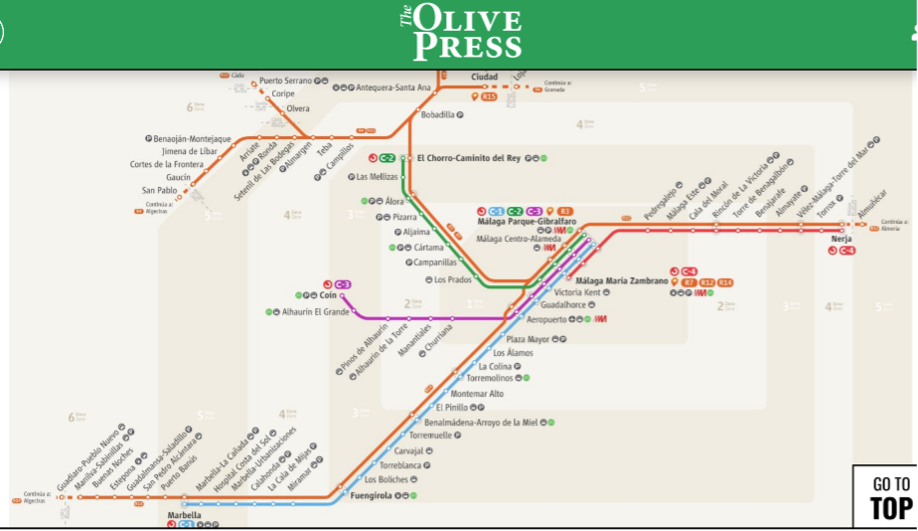
- Talking of infrastructure, the good news is that the Madrid and Sevilla Governments have at last decided that a coastal rail line is required. Still schemes to be drawn up, contracts awarded and land rights to be acquired, but it’s a start.
- The Olive Press published an ‘aspirational’ map of how rail lines could be created to serve this area of Málaga Province and nearby. Not official policy, but it’s nice to dream!
- Property Market and PricesAll of the above is background but we are here to talk of the property market and prices. Before we get into the numbers and professional opinions, we need to consider the following –
- Why are mortgages for land treated so harshly
Mortgages for land purchases are notably harder to obtain than those for buildings. They typically come with lower loan-to-value ratios, shorter repayment terms, and higher interest rates. But that defies logic. The land is always going to be there and will need little maintenance to keep its value, whilst a house naturally deteriorates and needs regular maintenance. The value characteristics of land, geomorphology and location are only likely to improve over time. A house on the other hand can lose fashion, be squatted, or have any manner of problems. So, why is land penalised?
https://surveyspain.com/2025/11/03/why-are-land-mortgages-treated-so-harshly.html - Pre-fabricated houses
These are being touted as the ‘new’ solution to Spain’s housing problem as they are normally cheaper to build, quicker and the quality is easier to control. I’m old enough to remember pre-fab housing in the UK in the 1950’s which were the answer to housing for our heroes returning from the war to the brave new world. But how will the banks treat them? Will they be accepted for mortgages, insurances, etc at reasonable rates and for what length? Depending upon their quality they may need more maintenance than a conventional house and have a shorter obsolescence time. How will fashion treat them over time? Admire them or liken urbanisations of them to trailer parks? Timber kit houses have always had problems due to their supposed ‘portability’, so that only the serviced site was valued by the bank. - Tasador strike.
- Currently, and promised to continue to the middle of February at least, an organisation of mortgage valuers, Tasadores, has gone on strike.
- “Without well-paid appraisals and decent working conditions, there can be no secure mortgages or a reliable real estate market, because the precarious situation of those who visit properties, analyse documentation, carry out checks and sign valuations reduces the time available per report and increases the risk of error”.
- We can sympathise with them as often the individual valuer is paid a very small % of the fee charged by the bank to their potential borrower. To make a living they must do many inspections and reports, which means they cannot provide a professional result. We’ve seen some shocking reports that would certainly not be accepted by Survey Spain
- Will the banks and tasadores company intermediaries accept less % so they can pass on more to the individual usually self-employed valuer? Unlikely, so mortgage costs will go up.
- At a time of greater use of AI and opening of sales information by the Notaries, it’s perhaps a risky, but urgent manoeuvre by the tasadores. They will always be needed as AI and aerial photos cannot inspect the condition and internal peculiarities of individual properties. But maybe the banks will just take the risk and depend on technology alone.
- However, when a market crash comes, as it always has, who will they blame for their imprudent lending? See comment on the Notary Portal below and https://surveyspain.com/2015/03/30/mortgage-upside-down/
- Changes to measurement,
- As a result of pressures from environmental bodies, the International Valuation Standards Council (IVSC), has recognised the needs of property appraisals to take environmental factors more into consideration. The IVSC sets global standards for property and asset valuation. The Bank of Spain has amended its Regulation for Tasadores, and RICS has too, bringing in mandatory changes at the beginning of 2025.
- Most responsible residential valuers will have been taking these into account anyway as the environment around a property is often what creates or limits a substantial part of its value.
- One item that Bank of Spain has regulated on is the basic element of most valuations, the floor area. The Bank has instructed Registered Valuers to use the internal (Utíl) area instead of the normal external (Construido). That is going to make property comparison much more difficult as Catastral and Registrar sizes are always the external area.
- So, conversions will need to be made, which will lead to even more uncertainty. Perhaps in the cities this made some sense where external measurement of apartments was impossible and internal were normally used and then a factor added to allow for the thickness of walls. Now, it’s going to have to go the other way in all buildings, with the unknown deductions for stairways and the like needing to be guessed at.
- A valuer’s life is not an easy one.
- Notary Portal re Prices
- The Notaries have now made available summaries of actual sale prices for properties. This has been billed as a “game changer” for the property industry, previously starved of actual sales information, unless directly involved in the negotiation. Even then, elements of the price passed ‘under the table’ could only be known to very few.
- But, (there’s always a “but”), the portal can only narrow down to Post Code level. That is only comparing ‘resale’ ‘houses’ in quite a varied market, not necessarily comparing like with like as it includes all house types, ages, conditions, locations, planning, legality, etc, of the houses sold, which will be different for each yearly period.
- The rate per sq m cannot be reliably applied to a particular property.
- However, it does give an indication of the way the local market has gone over that period.
- New Properties can be ignored as the values there will have been agreed at the off-plan stage, which could have been 2 years before.
- Rural Market
- With prices on the Costas reaching levels the normal buyer can no longer afford, there is a surge again in interest “over the mountains” and to the smaller villages beyond. Previously cut off from amenities, with increasing populations they are coming back to life. Spain’s investment in countrywide internet links and the availability of solar panels for electricity, means that modern out of office living can be combined with rural pursuits on the doorstep. It’s also where growing families will want to be away from the high prices of the cities and in cleaner, less pressured environments for their children. (See Agency comments below)
- Idealista reports that a study of prices shows that properties outside the bigger cities and towns are generally about 50% of the price of the equivalent sq m in the city.
- Estate Agent Registration in Andalucia
- Yes, it’s happening! As from 24th January 2026, all residential estate agents in Andalucía must register in the official Registro de Agentes Inmobiliarios Especializados del Sector Residencial. This is not optional—it’s a legal requirement for practising in the region.
- Agencies will have up to January 2028, or maybe even earlier, to get their business in order. That requires –
- A Professional Property related qualification OR a university degree in social/legal sciences, engineering, or architecture.
- Ongoing compliance, including CPD (Continuing Professional Development).
- Professional indemnity insurance (minimum coverage typically €600,000).
- Bank guarantee or bond if handling client funds.
- A physical office in Andalucía or a registered address for online operators.
- All well and good, but unfortunately, despite the imminent implementation, there doesn’t appear to be a site for Registration as yet. No doubt it will appear soon!
- The details of the requirement are included within an Order that includes many regulations regarding residential property, with Article 49 and onwards being the ‘estate agent’ section – Ley 5/2025, de 16 de diciembre, de Vivienda de Andalucía.
- Value, Prices and Worth
- Matching those between seller and buyer is the real skill of the agent. As defined in https://surveyspain.com/2025/05/29/spanish-property-worth-value-price.html
- Why are mortgages for land treated so harshly
 STATISTICS
We continue to keep an essential record of the average difference between Asking Price and Actual Selling price, where we have been supplied with that information from reliable sources. These are often from clients for whom we have carried out a building survey/home inspection, and they inform us what price they are actually paying for the property after receiving our report. We can use that information to improve the accuracy of our current market valuations.
Average Difference Between Asking Price and Actual Selling Price.
July to December 2024 – 7.76% (July to September 7.22% and October to December 8.31%)
A substantial increase since the first half of the year.
January to June 2025 – 8.76% We had fewer records to work with, but noted that the first quarter, January to March was a substantially bigger difference than the 2nd quarter.
July to December 2025 – 7.62% A slight fall since the last half year, most probably caused by the shortage of property lessening the negotiating strength of the buyers. It must be remembered that this is an average of all the Regions of Spain in which we are active and varies from -11% to only -1.25%, with one registering as having paid the asking price.
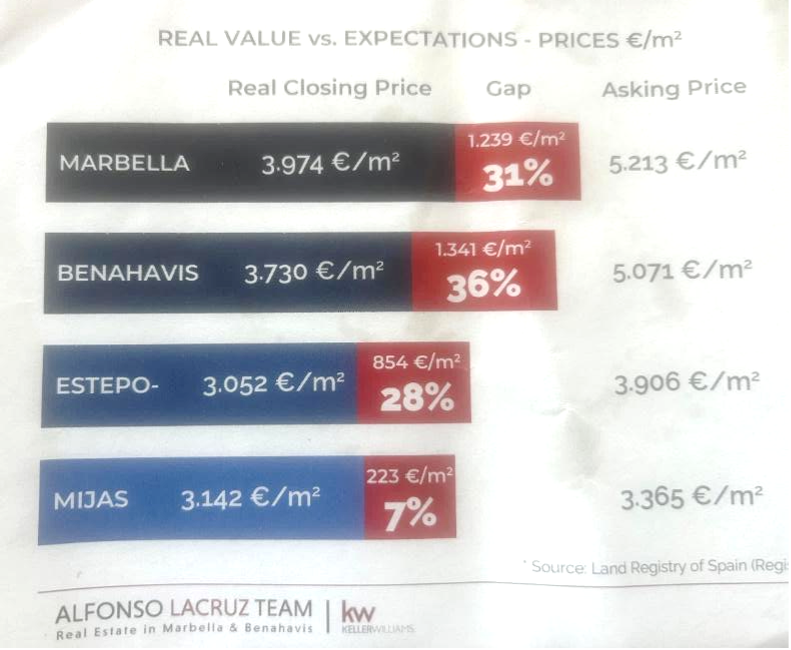
Alfonso Lacruz Agency has published research that we assume they have done by comparing The Registered Sale Prices of properties they know, with the Asking Prices advertised on Idealista (a major multi-listing website). These show some surprising variations that certainly should not be taken as the rule, but perhaps are more of an indication that the buyer can achieve discounts and is resisting ever increasing prices.
 Changes in the last 6 months – in Multi-Listing Site – Resales Online
Comparison of figures are restricted to one region, and we have chosen Costa del Sol, as being the most active on the website. July 2025 figures in brackets.
We found on 23rd January 2026 that there were:
- 11,702 properties for sale at 100,000€ euro or more. An increase of 4.7% on our last recorded analysis (11,176) in July 2025, which had seen a slight increase (0.1%)
- 3,810, 32.5% were priced at 1,000,000€ euro or more. That’s 4% more in number than 6 months before (3,659), and but slightly lower in % (33%).
- 473, 4% of the total of 100,000+€ euro, were identified as representing new developments, a significant increase in number and nearly 20.7% more than the (392) last time,
- 298, 63% of the total of new developments were priced at more than 1M€ euro, an increase in number (249) but similar % (64%) from last time.
- 1,322, 11.3% of the 100,000+€ euro properties are found to have a discount of -10% or more since first listing, which is more in number and % than the previous analysis (1,142) (10%)
- Those increasing their price by +10% or more was 733, 6.3%, which is slightly lower than the previous period. (760) (7%), which was similarly lower than the period before.
- 491, 12.9% of the 1M+€ euro properties were found to have reduced their prices by 10% or more, being marginally more in number and % than previously (456 12.5%), again continuing a trend.
- 356, 9.3% of the 1M+€ euro properties to have increased their price by +10% or more, being the same number but less % than the last period. (357, 9.8%)
- 1,529 were found to be available for long-term rental, an increase of 16% from (1,316). Perhaps this is an indication of transfer from short-term to long-term.
- 97, 6.3% being available at 1,200€ euro per month or less, again a reduction from the (105, 8%) last period reflecting the general increase in rents.
- 907, 59% were available at 2,500+€ euro/month, an increase in numbers but similar %. (796, 60%) to the first half of the year.
- 348, 22.8% at 5,000+€ euro/month, a marginally higher number but less % since July. (340, 26%)
- 1,161 properties are available for short-term rental in this holiday season, less 11.4% than January. (1,311) again perhaps indicating the influence of the licencing requirement
- Only 138, 11.9% of these properties are shown to have a short-term licence number, very similar to July. (141 10.8%). The agents are putting great trust in the paywall of Resales Online!
 Analysis
- This is just one listing agency, and some new ones are starting up, so there could be differences if all listing agencies were included.
- Idealista shows 16,212 properties for sale in all Costa del Sol to the border of Málaga to Cádiz provinces, and 2,965 to Rent.
- The asking price per sq m in December 2025, covering all property types is 4,047€ euro/sq m, being an increase of 6.7% since July 2025.
- The Rental at 16.6€ euro/sq is a decrease of only 0.1€ euro/sq over the same period
- The biggest change in Resales is in the number of new developments listed, which is not a surprise seeing the number of cranes on the horizons.
- Otherwise, there is little real change in % and direction, indicating a market drifting upwards.
 Climate Crisis
Nature has performed Carbon Capture for eons, safely burying surplus carbon as oil and gas.
But we have released much of that in a few decades.
Also, the assets of the world are finite
but we have been profligate in their use and not recycled.
Now we live with the consequences of these actions.
All of us have no choice
but to reduce our own ‘carbon footprint’ and recycle and repair,
changing to the new reality lifestyle today,
and not wait until tomorrow.
Nature doesn’t respect Mañana.
Invocation to Rotary Marbella-Guadalmina